




Making institutional values part of everyday behavior
Organizational values are often clearly defined — but rarely experienced.
In this case, the company had a set of ten institutional values.
They existed as formal statements, but were not actively present in the daily experience of employees. As a result, they remained abstract, difficult to recall, and disconnected from behavior.
The challenge was not to communicate the values once, but to make them visible, familiar, and naturally integrated into everyday routines.
Approach
Instead of treating values as static content, the approach focused on behavioral exposure through space.
The starting point was to understand how people interact with their environment on a daily basis:
- entry and exit points
- circulation paths
- shared spaces (cafeteria, rest areas)
- transitions between tasks and floors
These moments were identified as natural opportunities for communication.
Rather than interrupting workflows, the strategy was to embed the values into these existing patterns, allowing repeated and contextual exposure throughout the day.
Solution
A spatial communication system was developed and deployed across three office floors.
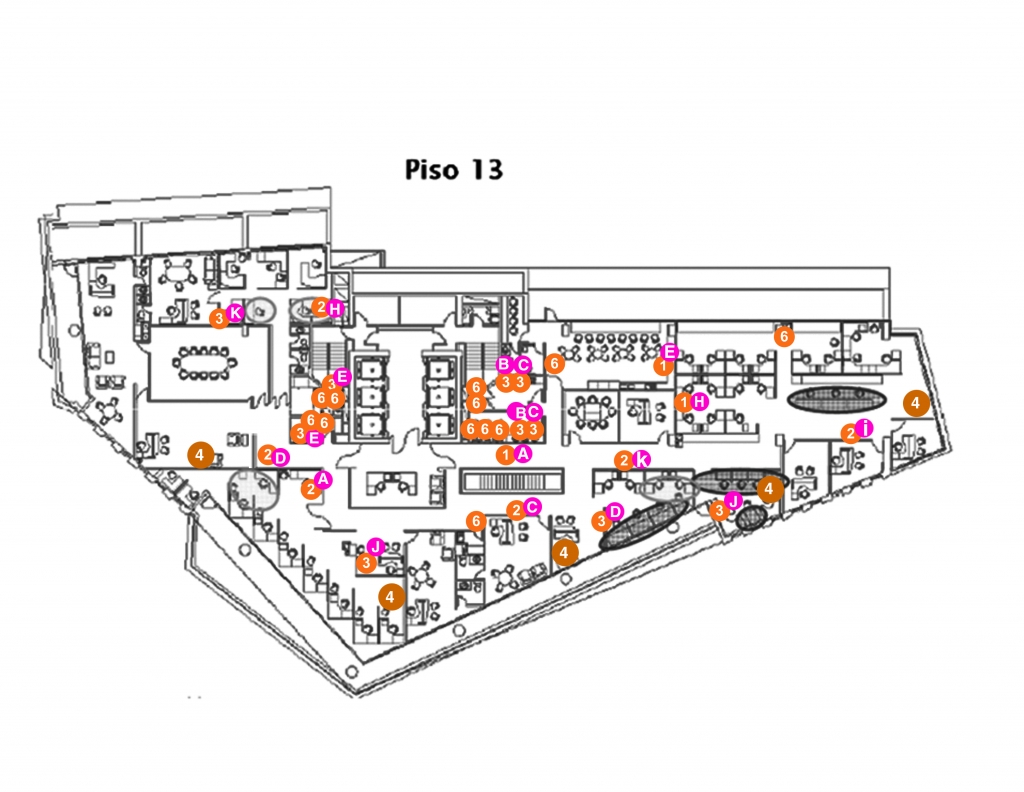
The system:
- distributed the ten values across key movement points
- aligned each message with specific moments in the daily journey
- ensured visibility without disrupting the environment
- created repeated exposure through natural circulation
The implementation was carried out in phases, allowing consistency and adaptation across different areas of the workplace.
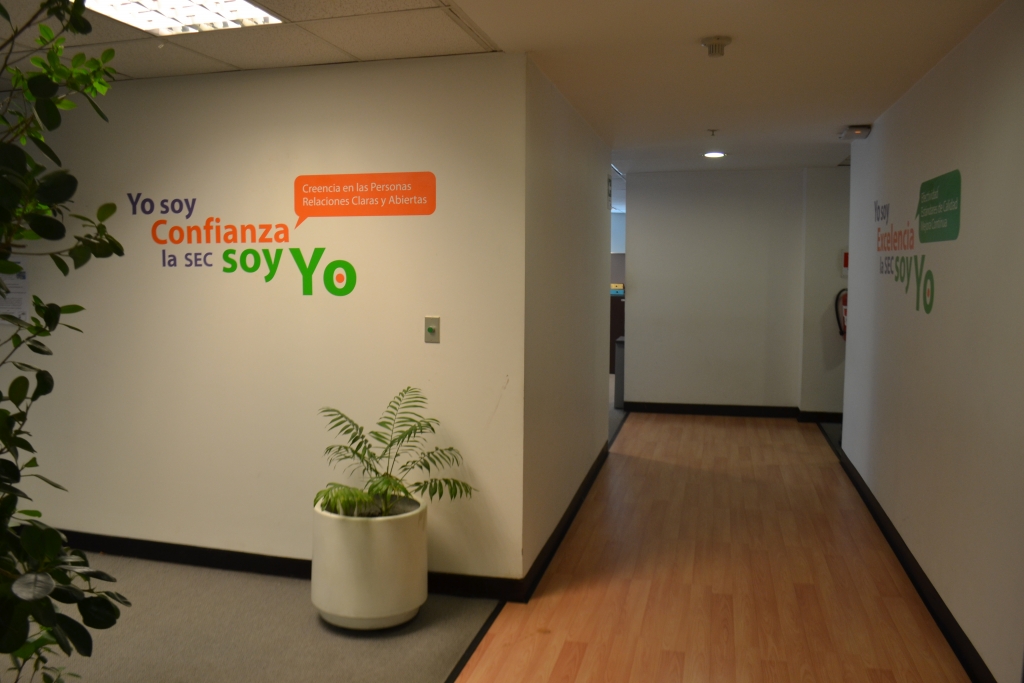
Outcome
The values shifted from abstract statements to constant, ambient references within the work environment.
Through repetition and contextual placement, employees were able to:
- recognize the values more easily
- recall them during daily activities
- associate them with real situations
This reinforced a sense of belonging and alignment with the organization.
Insight
Communication is not only about delivering messages — it’s about designing how and when people encounter them.